
“Art comes from joy and pain… but mostly from pain”
Edvard Munch was born in 1863 in Løten, Norway to a middle-class family plagued by illness and death. His mother died of tuberculosis when he was 5, and his favorite sister Sophie passed away from the same disease when Munch was 14. These tragic losses, along with his father’s fundamentalist Christian beliefs, had a profound impact on the young artist. Munch felt that “illness, insanity, and death” were constant companions throughout his life.
Despite his frail health, Munch showed an early talent for drawing. He began painting in oils as a teenager, inspired by the landscape works of the Norwegian Art Association. Munch’s artistic development was also shaped by the Kristiania Bohème, a circle of writers and artists who encouraged free expression and opposed bourgeois conformity.
Artistic style:
Munch used bold, symbolic colors to convey emotion and psychological states. He was inspired by the vibrant palettes of Post-Impressionists like Gauguin and Van Gogh.
His figures and forms are often rendered with sinuous, tortuous lines that seem to express inner turmoil. This style emerged in the early 1890s as he moved away from naturalism.
Munch focused on universal themes like love, anxiety, and death, using them as symbols of the human condition. His most famous works, like The Scream, became icons of modern angst.
He favored a semi-abstract, gestural approach to painting, with visible brushstrokes and a lack of photographic realism. This lent his works an intense, immediate quality.
In addition to painting, Munch was a master printmaker, producing haunting lithographs and woodcuts. His graphic works were crucial to the development of Expressionism.
Most important works:
The Scream (1893): Munch’s most famous work depicts a nightmarish figure against a swirling, blood-red sky. It expresses a cosmic level of anxiety and anguish, inspired by a hallucinatory experience the artist had. The Scream has become an icon of modern spiritual anguish.

Madonna (1894-95): A mysterious, sensual woman with flowing red hair appears against a dark background. The painting combines themes of love, fertility, and death. Munch created several versions exploring this subject.

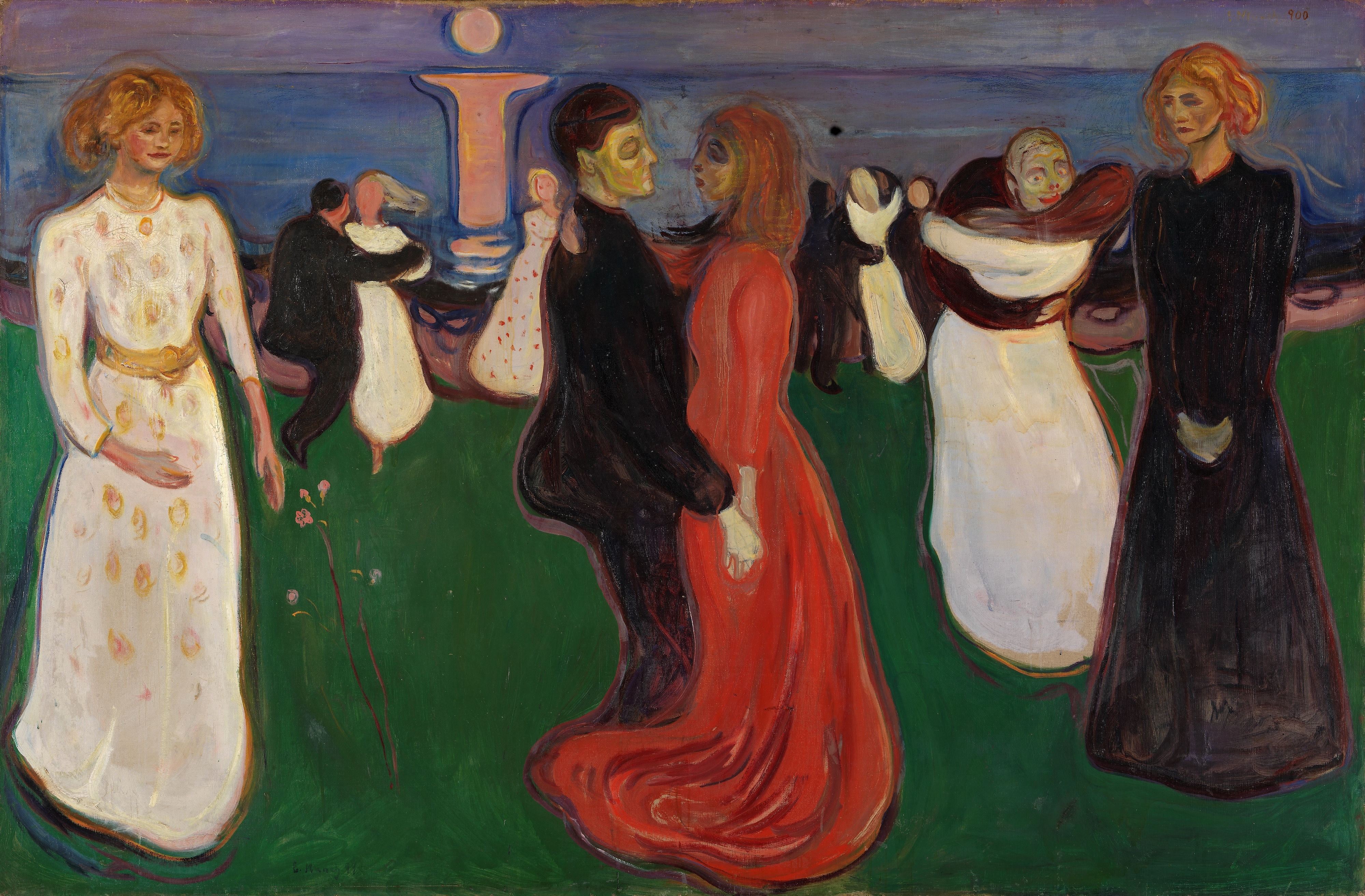
The Dance of Life (1899-1900): This large canvas depicts three female figures representing the stages of life – youth, maturity, and old age. They dance in a circle, symbolizing the cycle of existence. The painting exemplifies Munch’s style and themes.
Anxiety (1894): A central figure with a distressed expression is flanked by two shadowy, ghostly forms. The painting captures a profound sense of psychological unease and isolation.

Separation (1896): This painting is a significant work that explores themes of loss and emotional turmoil. It features a man and a woman in a poignant moment of parting, with the woman depicted in luminous shades of white and gold, symbolizing her strength and presence. In contrast, the man appears subdued, dressed in dark colors, which conveys his sorrow and vulnerability during this emotional separation.

Exhibitions:
1. Edvard Munch: Trembling Earth
Location: Munchmuseet, Oslo, Norway
Dates: April 27, 2024 – August 24, 2024
This exhibition will explore how Munch used nature to convey deeper meanings in his work. It will feature over 75 pieces, including landscapes, self-portraits, and prints, showcasing the relationship between Munch’s art and the natural world.
2. MUNCH. Il grido interiore
Location: Palazzo Reale, Milan, Italy
Dates: September 14, 2024 – January 26, 2025
This major retrospective will present over 100 works, including paintings, drawings, and prints, all borrowed from the Munch Museum in Oslo. Curated by Patricia G. Berman, the exhibition will cover Munch’s artistic journey from 1880 until his death in 1944, emphasizing his emotional and psychological themes.

Scopri di più da APPOART
Abbonati per ricevere gli ultimi articoli inviati alla tua e-mail.
Comments